

DonnKill Vet — Veterinary Medical Records Management System
A web platform for veterinary clinical management and follow-up, initially developed as a final degree project and subsequently expanded.


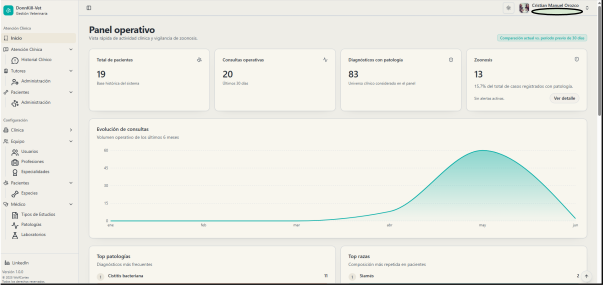
Problem and context
Many veterinary clinics manage patient information using paper records, scattered spreadsheets, or disconnected tools. This makes it difficult to track owners, patients, consultations, clinical history, veterinary observations, and related documents.
DonnKill Vet digitizes veterinary clinical follow-up, bringing patient and owner information together in a structured, secure web platform designed to evolve.
The system helps record, retrieve, and track veterinary clinical information, reducing reliance on paper or isolated records and improving the organization of data associated with each consultation.
My role
I contributed to the design and implementation of the complete solution, covering backend, frontend, centralized authentication, data persistence, service integration, file storage, and container deployment.
- Functional analysis of the veterinary domain.
- Service-based architecture design.
- REST API development.
- Business logic for clinical follow-up.
- Data modeling and persistence.
- SSO authentication and authorization.
- Frontend and backend integration.
- File storage configuration with MinIO.
- Containerization and environment deployment.
- Technical and functional documentation.
Overall architecture
DonnKill Vet uses a microservices architecture that separates the system's main responsibilities to support scalability, maintainability, and security.
The solution includes a Next.js and TypeScript frontend, a Java and Spring Boot main backend, a separate SSO authentication and authorization service, REST APIs, PostgreSQL persistence, MinIO file storage, Redis for internal processes, Kafka for communication and events, and Docker containers.
This separation keeps authentication independent from the clinical module, improving system organization and allowing the identity service to be reused in future projects.
Results and current status
The project applied software architecture, security, centralized authentication, fullstack development, persistence, service integration, and container deployment.
The result is a functional, deployable platform ready for a controlled demonstration, with an architecture designed to evolve and incorporate future modules.
The web frontend and SSO service are currently deployed. Unrestricted public access is not permanently enabled, to avoid exposing data, credentials, or internal functions. A demonstration can be requested in a controlled environment using fictitious users and data.
Technologies
- Java
- Spring Boot
- Spring Security
- OAuth2
- OpenID Connect
- JWT
- Next.js
- React
- TypeScript
- PostgreSQL
- MinIO
- Redis
- Kafka
- Docker
- JUnit
- Mockito
Architecture
OIDC / OAuth2 authentication flow · Authorization Code + PKCE
System screenshots
Case study
Read the summary on this page or consult the original document for more detail.
Original document in Spanish. The case summary is available in both languages.
Open PDF in a new tab